Sunday, April 10, 2016

Jovial Genève

Sunday started off a little later than the previous day. Rebecca and I went to Mass at Basilica of Our Lady of Geneva. It is the main Catholic church of Geneva. It was built in 1857 in the Neo-Gothic style. It is much smaller in size than St. Pierre's but provides a different atmosphere. Also, Mass was in French so add that to the list of languages that I've heard Mass in now. After church was over we went back to the apartment to pick up Hannah and grab some breakfast before tackling the events of the day.
Basilica of Our Lady of Geneva
We had a cluster of buildings we wanted to see on the north side of the lake so we set out. On the way we came across the Church of the Holy Trinity which was like no other church I have ever seen. It was in a giant sphere. It was very beautifully done. It was actually quite impressive. We finally arrived at the building we wanted to see which was JTI Headquarters by Skidmore, Owings, and Merrill (SOM). The building was located in the business district and it was made up of all glass and steel. A corner of the building was lifted up and cantilevered out and created a courtyard space of sorts. It looked really nice from the outside but seeing as it was both an office building and Sunday, the inside was closed.
Church of the Holy Trinity
JTI Headquarters
We walked up the street to the Palace of Nations which houses the United Nations Office of Geneva. This is the third of four UN buildings that I have seen in some fashion. The others locations are New York, Vienna, and Nairobi. I don't know if you could go inside but we had other things to see. Across the street was home to World Intellectual Property Organization  (WIPO) which had an architecturally significant tower and conference hall. The tower was nice but the hall was a little underwhelming compared to the photos I had seen. We couldn't go inside so we left.
WIPO Headquarters
We made our way over to the Conservatory and Botanical Garden of the city of Geneva which is a large park. We had lunch there and spent some time wandering and basking in the sun and warm weather. They even had some animals to show off. We had a lot of fun just sort of goofing off before we left. From the gardens, we walked up a series of hills to get to an overlook point. We weren't that high up, just under 250 feet above Geneva's elevation but you could see a lot. We were about a mile from the French border and the French Alps loomed over everything. On the other side you could see a lot of Lake Geneva and the Swiss Alps. It was a beautiful spot.
At the Botanical Gardens
Overlooking Lake Geneva
We made our way back down to the city center from the overlook after a long walk and decided to have a little fun. We rented a paddle boat for half an hour out on the lake. It was so much fun! The water was so clear and the sky was blue and the weather was great. It was perfect. Once we got done with boat we had sorbet to complete the embrace of the warm weather.
Paddle boating in Lake Geneva
The last stop to see was the Julius Bär Bank by Mario Botta. We tried to see this the day before but our directions were misinformed. Today we found it and knew it was Botta from first glance. It was a tall building clad in a stone rainscreen. I really liked the material choice and thought that building was very cohesive. Obviously, banks on Sundays aren't open so we left.
Mario Botta Bank
Geneva is not a cheap city so it took some time to find something relatively cheap enough for a student's budget. Naturally, we found a pizza place and ate there. It was relaxing to finally be off my feet for awhile. Afterwards we came back to the apartment and called it a night. I really enjoyed Geneva and I am glad I got to visit. Au revoir Genève!

Geneva, The Peace Capital

Today started at the dark and early time of 3am. Rebecca, Hannah, and I had to catch a train at quarter after 4am to Lugano Airport to catch our flight at 7am. The airport was the smallest I had ever seen. It was almost a joke. The flight time was only 35 minutes to get to Geneva, the second largest city in Switzerland. The flight was great though as we flew over the Swiss Alps. They were breathtaking and I actually had chills the entire flight because of how beautiful they were. Once we got to Geneva though we hit the ground running.
Swiss Alps
Once we got to our Airbnb and dropped our stuff off we headed towards the waterfront in search of breakfast. We got some sorely needed coffee and pastries while drawing up the gameplan for the day. We first attempted to go the Grand Theatre of Geneva but it was completely covered in scaffolding so we crossed the street to the Conservatoire de Musique de Genève which is the oldest music school in Switzerland and one of the oldest in Europe. From there, just around the corner at Plainpalais was a weekly flea market. It was cool to walk through and see what the locals had to offer. The park was also playing host to Luna Park, a traveling carnival, so we marked it down to come back when it opened and went on.
Conservatoire de Musique de Genève
The next stop was the Bibliothèque Publique et Universitaire or Library of Geneva. This library dates back to 1559 and is one of the oldest university libraries of Switzerland. The library was nice and showed its age but we mainly used to it to get out of the cold and for the free Wifi. We made the trek up the hill to St. Pierre Cathedral. This church is actually home to the Protestant Church of Geneva and used to be a Roman Catholic church. It is also a hodgepodge of architectural styles and it started in the Romanesque in 1160 before being completed in the Gothic and then having a Neo-Classical facade added much later. The church was pretty bare inside as most of the symbolism used by Catholicism had been rejected. It made the church nicer on the interior. You could also go up into the towers and cupola so we took advantage of the that. There were some gorgeous views of the city, the lake, and both the French and Swiss Alps.
St. Pierre Cathedral
We got a short lunch after the church and went off in search of Immeuble Clarté which is an apartment building completed by Le Corbusier in 1932. It was interesting to see this building as it was the one that led him developing Unité d'habitation (one of which I saw in Marseille). It didn't seem to have the typical Corbu points but it was nice to see all the same. We couldn't go inside so we set off back to the waterfront.
Immeuble Clarté
We walked up and down the waterfront of Lake Geneva for awhile just admiring its beauty. We noticed the world famous Jet d'Eau, a water fountain that expels water up to 459 feet into the air, was not running. We found out that it was closed due to construction work occurring on the walkway out to it. It was so disappointing. We saw the L'horloge fleurie which is the second largest flower in the world. The waterfront is beautiful area to just wander around.
L'horloge fleurie
We were exhausted since we had been going nonstop for about 16 hours so we went to the apartment to nap before dinner. We found this reasonably priced chicken place that ended up being delicious. To end the night we walked around Luna Park for bit before heading off to bed.

Sunday, April 3, 2016

Hiking Monte San Giorgio

Today was our first full day back in Riva San Vitale. I couldn't spend it sitting around the Villa all day especially after a 10 hour bus ride yesterday so Rebecca and I decided to go on a hike. Riva San Vitale and the neighboring town of Capolago sit an elevation of 896 feet between two mountains. The two mountains are Monte San Giorgio and Monte Generoso. Since it was my first time hiking in awhile and in the Swiss Alps we went with the easier of the two, San Giorgio.
Monte San Giorgio
We started our trek at 1pm. We had to walk across town (only 5-10 minutes) to get to the start of the trail. Just getting to that point is a bit of a workout. The path was pretty steep at times and had a number of switchbacks. A couple times it leveled out and fooled us into thinking we were nearing the top only for it to get really steep. We knew we were nearing the top when we reached a meadow and saw little elevation left.
To the top!
We finally made it to the top of Monte San Giorgio at 3:20pm which isn't a bad time considering we took our time going up. It was overcast so the sun wasn't beating down on us but we still sweat quite a bit. The elevation at the top is 3,599 feet which means we climbed 2,703 feet or over half a mile up. The views were absolutely breathtaking from the top and it was totally worth hiking up. We spent half an hour or so at the top just snacking and taking photos before realizing we should leave if we wanted dinner.
View from the top
We started our descent at 4pm and went down the same path we came up. We made it to the base at 5:40pm. All in all it was a very successful trip and it was completed with very minor injuries but we both made it out alive! We rewarded ourselves with gelato at a local shop before heading back to the Villa. It was such an adventure and now I can check hiking the Swiss Alps off my bucket list!
Rebecca and me

Friday, April 1, 2016

One Day in Graz

It was time to leave Vienna to make our way to Graz. We made a short stop in the town of Mürzzuschlag to see the Kunsthaus Muerz. This art museum is in a former church which a structure built around it. The church is preserved but also modernized a bit. The updated structure was completed in 1991 by architects Konrad Frey and Andreas Ortner while the original church dates to 1657. It was an interesting use of adapting and repurposing while also seeing a unique structuring system.
Kunsthaus Muerz
After a short drive we made it to Graz which is the second largest city in Austria. We got to our hotel and then Hans took us on a walking tour of the city before letting us go to get lunch. We didn't really have time to see anything as we had 90 minutes to eat and be back at the hotel to actually check in to our rooms.

Once we got our rooms, a group of us set out to the Kunsthaus Graz. It is an art museum designed by Peter Cook in 2003 for the European Capital of Culture. It has since been nicknamed the friendly alien although I think it looks like a heart. It is a large building and stands out in stark contrast to the rest of the buildings in the city. The inside is pretty straight forward as museums go. The main draw is the second floor which is double height and the city is reflective of the exterior tower/tubes. It is actually a pretty impressive space.
Kunsthaus Graz
Next, we walked to Murinsel which is a large floating platform in the middle of the Mur River. It was designed by Vito Acconci in 2003. It resembles a sea shell and houses a cafe. The idea is pretty cool as it isn't an island but it is anchored to shore by two walkways on either side.
Murinsel
The last thing we had time for was making the trek up Schlossberg. It is a large hill overlooking the city and contains the remains of the old fortress. Some landmarks at the top are the Uhrturm and Glockenturm. There are also many great views from the top in any direction. It was a beautiful sight.
Looking over Graz from Schlossberg
It was finally time to head down and return to the hotel for dinner. This pretty much concludes our Austria trip and our organized travel for Riva Spring 2016. Tomorrow we make the 7+ hour bus ride back to Riva San Vitale to continue our studies.

The Sun Sets on Vienna

The day started early enough as we made our way out to the Karl Marx-Hof which is a public housing complex completed by a student of Otto Wagner, Karl Ehn in 1930. It is one of the best examples of public housing in not just Vienna but anywhere. It is also just over a kilometer long making it the longest residential building in the world. We couldn't go inside because the apartments are private but I was able to read a lot from the exterior. There was a quite a bit of communist symbolism going on but it was still a well designed building.
Karl Marx-Hof
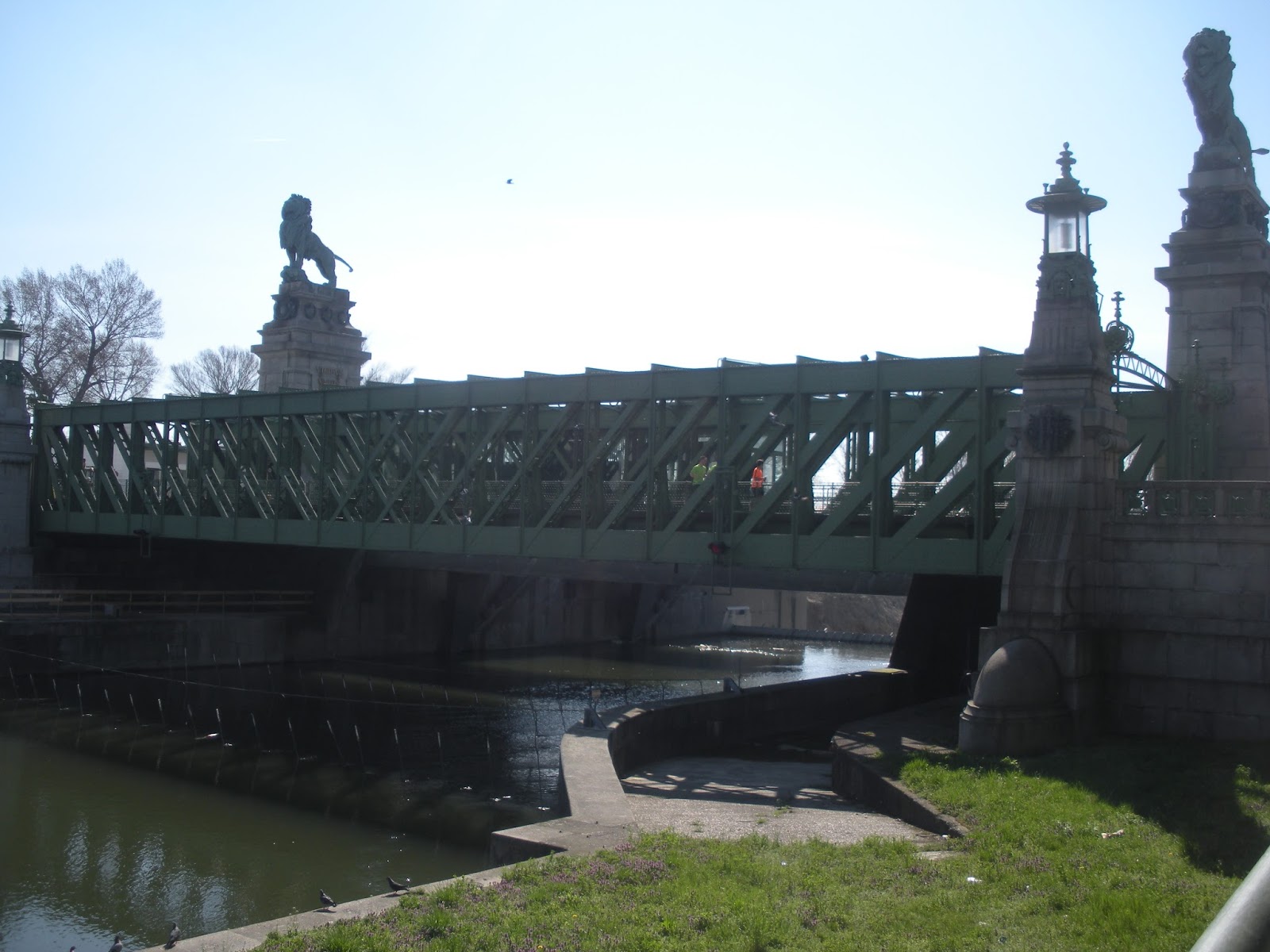
Our next stop was the Schemerlbrücke which is a bridge over the Danube Canal. It was designed by Otto Wagner and represents an entry into the city. It also contains a weir and lock to assist boats down the canal. We have learned quite a bit about this structure in the past and it was nice to see it. Also my impression of it was different than what I had seen in photographs. I thought it was more centrally located and was in a grander location. It was still a beautiful bridge and intricate structure though.
Schemerlbrücke
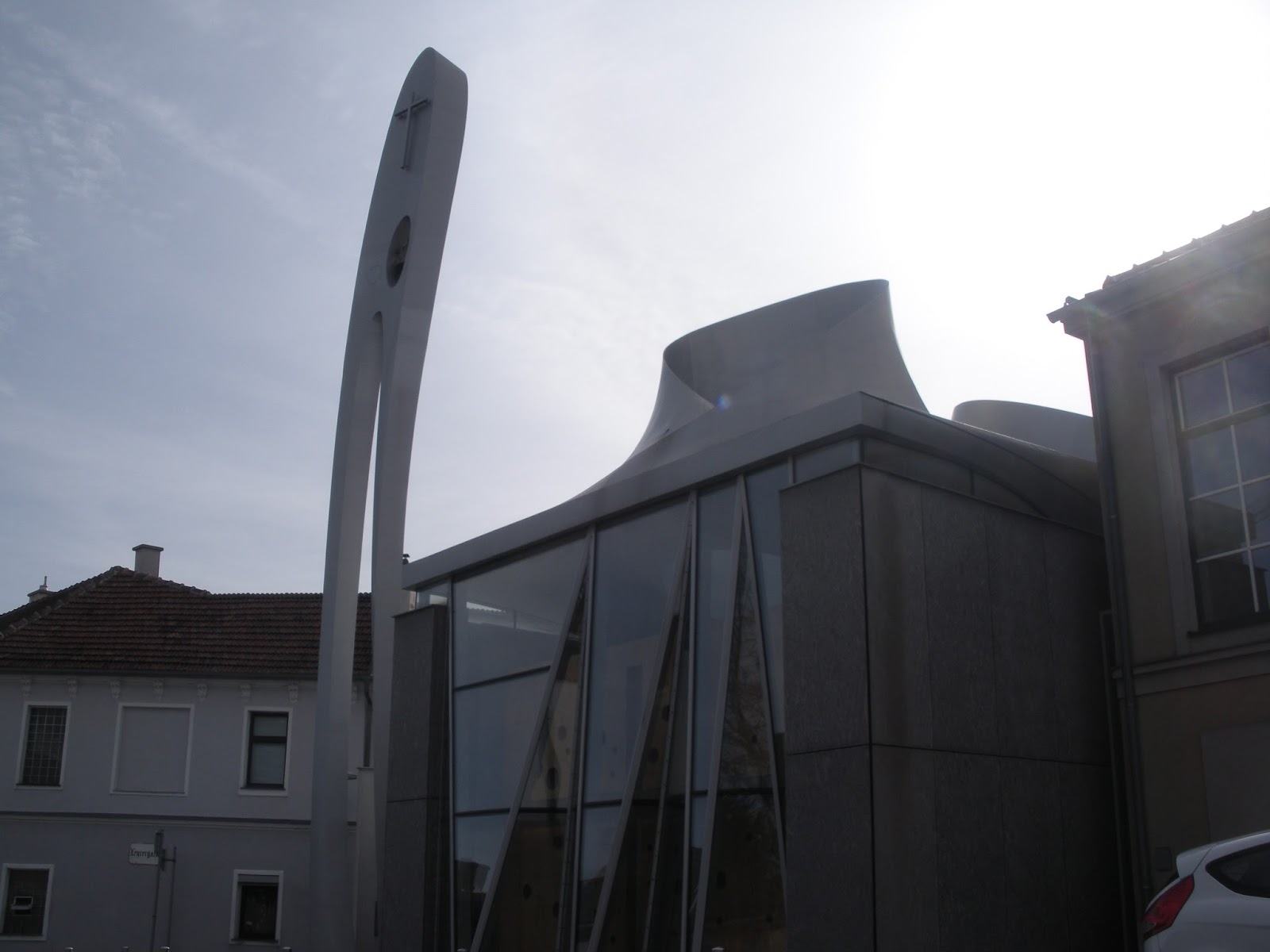
We drove into the heart of Vienna to Donau City where a United Nations building and Vienna's tallest skyscrapers are located. Here we went into the Donau City Church which is a Roman Catholic parish church completed in 2000 by Heinz Tesar. It was a small church with an all wood interior with circular windows of varying sizes all over. The exterior of course carried the windows through while being clad in black metal panels. It was sort of weird to have this small church in the middle of all these tall buildings but it felt nice.
Donau City Church
I was looking forward to this next stop since the previous day when we passed by them on the highway. This complex of buildings is called the Gasometers. They are four large coal gas containers that have since been closed down and repurposed for various needs. The exterior is original brick facade from 1899 while inside has been updated. Each gasometer is reflective of the architect that worked on it. The four architects are Jean Nouvel, Coop Himmelb(l)au, Manfred Wehdorn, and Wilhelm Holzbauer. The program ranges from housing to shopping to restaurants and entertainment. It is such an experience to be in a building which so much character from old meets new. I really liked the idea behind these buildings and the execution was well done.
Gasometers
This stop is the one I have been waiting to see for a long time. This is the Postal Savings Bank completed by Otto Wagner in 1906. This a beautiful example of modern architecture. We could only see the main entry room and a small musuem dedicated to Wagner but it was worth it. He designed every detail in the main room. There is a glass ceiling that allows light to come through and down through the glass floor to the bookkeeping areas. There are gravity fed air vents of his own design that are so iconic. These building was everything I studied about and I was overjoyed to get to see it.
Postal Savings Bank
From there Hans led us on a walking tour through part of the city. We ended up in the major square of Stephansplatz at St. Stephen's Cathedral. It was originally done in the Romanesque style in 1160 but was eventually enlarged and added on to its current Gothic designation now. Across the street was the Haas House which a contrasting piece of modern architecture whose facade is completely reflective glass allowing the rest of the square to be seen.
St. Stephen's Cathedral
After the square, Hans let us go and some of us took a leisurely stroll back to the hotel passing by the Loos American Bar designed by Adolf Loos and through the Volksgarten park. We made it back to the hotel to meet Hans to go to dinner at Zum Martin Sepp. It was a pay by weight buffet place which was absolutely delicious. It was an enjoyable way to end my time in Vienna.

Rest in Peace Zaha Hadid. You were an inspiration to not just architects but to women as well. You always pushed the envelope and drove architecture to new heights. You were an innovator. It is so weird because just in January I saw her main office. And then two days ago I was in her building. The architecture world lost a bright mind too soon.

Wednesday, March 30, 2016

Venturing Out of Vienna

The day started at the early time of 7am. We had quite a bit scheduled for the day so off we went. The first stop was a ways out of town in Hainburg which is about 90 minutes away. It is about 5 miles from the Slovakian border. We went to a small church called Martin Luther Church designed by Viennese architects Coop Himmelb(l)au. They are also the architects of BMW Welt in Munich. It was a stark contrast between the two buildings. It really shows the range that Coop Himmelb(l)au is able to operate. The church was very small and the absolute max capacity was around 120 people. It was a cool little find in the middle of nowhere.
Martin Luther Church
I was hoping that would continue another 5 miles or so into Slovakia and its capital Bratislava but we started back to Vienna. Just a few miles down the road we came to Carnuntum. It was an old town that was a relic of the Holy Roman Empire. They reconstructed a lot of the buildings on the original foundations and set up the area like how it used to be. It was interesting to walk through but my interest wasn't piqued. I was more interested in a wooden playground on the site. From there we made our way back into the city of Vienna.
Roman Ruins in Austria
We stopped at another church this one called Church of the Most Holy Trinity or more commonly known as Wotruba Church. It was designed in the mid-1970s by sculptor Fritz Wotruba and architect Fritz Mayr. It is a very startling church. The whole design is based around these concrete blocks laid mostly vertically and glass windows placed between. This creates a very interesting interior and exterior condition. While it was intriguing to see I personally didn't like it.
Wotruba Church
We continued into the heart of the city arriving at Schönbrunn Palace which was the summer residence for the Habsburg Dynasty, the royal family of Austria. It was a very formally designed building as one would expect from a palace. We sort of rushed through the palace as every room looked the same and we wanted to see the gardens. Behind the palace lies the gardens, a zoo, a large 200 foot tall hill, and the Gloriette. This provided gorgeous views of Vienna and the surrounding area, We also got a quick bite to eat here before going on our way.
Rear of Schönbrunn Palace
The last stop of the day was the Church of the Holy Spirit designed by Jože Plečnik (who also designed a church I attended Mass in Prague). This church was similar to the one I saw in Prague albeit completed earlier. The rectangular/square open plan is readily apparent. It is of great use in churches where it provides satisfactory views of the altar from other seats. I enjoyed this church although I liked the one in Prague better.
Interior of the Church of the Holy Spirit
We bused back to the hotel following the church and had the rest of the night to ourselves. We had a group dinner at the hotel without Hans as he was visiting some family. It was nice to have a relaxing evening. Tomorrow, Hans has some buildings planned to see on the outskirts of the city.

Tuesday, March 29, 2016

The Vienna Voyage

Today is the first full day in Vienna (or Wien in German) and it was pretty packed. We started by taking a bus across the city to the first stop which was the Vienna University of Economics and Business. The new campus for the university was completed in 2013 after just three years and costing just under €500 million. The buildings were designed by Zaha Hadid, Laura P. Spinadel of BUSarchitektur, NO.MAD Arquitectos, Estudio Carme Pinós, Hitoshi Abe, and Peter Cook. Most of the buildings were pretty cool and responded well to the needs of the university though some of it seemed unnecessary. Despite that, the campus was pretty well laid out.
Library and Learning Centre by Zaha Hadid
The next stop was also a college called the Vienna University of Technology. We met up with the architect who did restorations/renovations and got a personal tour from him. The main stop of the tour was the cupola at the top of the building. It was a very interesting room to see. The structure was exposed and readily apparent. Once the tour was over it was time to go next door.
Cupola Hall at Vienna University of Technology
Just two buildings down was the Karlskirche. It is a church built by Johann Bernhard Fischer von Erlach and dedicated to Saint Charles Borromeo. It is considered one of the best baroque churches in Vienna and most outstanding buildings in the city. We have learned about this building a lot throughout our time in school. The plan isn't the typical plan of churches I usually see and its basis is around the elliptical dome. The drawback to this church is that there is scaffolding up to allow visitors to reach the top of the cupola. This takes away from the beauty of the church greatly. Plus it really isn't worth the visit to the top of the dome. There wasn't a whole lot to be seen. We finished up with the church pretty quickly and Hans took us on a walking tour.
Karlskirche
We walked around for a bit seeing some of the city before going to the Austrian National Library. It was built again by Johann Bernhard Fischer von Erlach in 1723. It was a very beautiful library and very elegant. I was thoroughly impressed with the building. There was so much history in the place that was also part of the palace. I wish I could've appreciated it more but I was super hungry after not being able to eat lunch. So Hans let us go and a group of us left to get dinner.
Austrian National Library
We made our way to Naschmarkt and had dinner. I had finally had true Wiener schnitzel made with veal. It was very good and delicious. We digested dinner a bit before heading back to the hotel. On our way we stopped at the Westbahnhof which is the main train station for West Vienna. It looks similar to the CCTV Headquarters in Beijing by OMA. Underground is a mall which we walked through. We decided to call it an early night being we start our day at 7am tomorrow, I hope whatever Hans has in store for us is great.
Westbahnhof