Friday, April 1, 2016

The Sun Sets on Vienna

The day started early enough as we made our way out to the Karl Marx-Hof which is a public housing complex completed by a student of Otto Wagner, Karl Ehn in 1930. It is one of the best examples of public housing in not just Vienna but anywhere. It is also just over a kilometer long making it the longest residential building in the world. We couldn't go inside because the apartments are private but I was able to read a lot from the exterior. There was a quite a bit of communist symbolism going on but it was still a well designed building.
Karl Marx-Hof
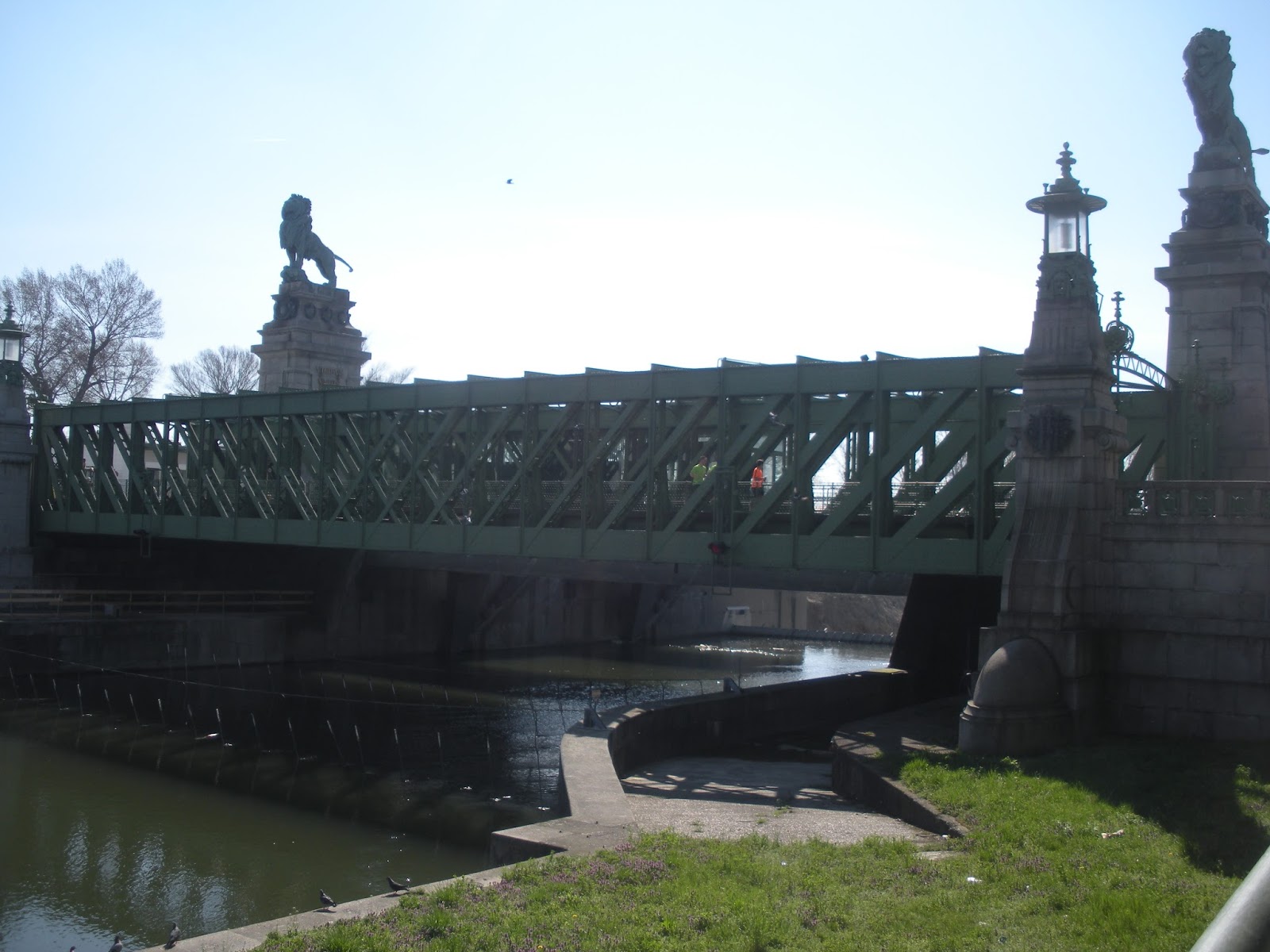
Our next stop was the Schemerlbrücke which is a bridge over the Danube Canal. It was designed by Otto Wagner and represents an entry into the city. It also contains a weir and lock to assist boats down the canal. We have learned quite a bit about this structure in the past and it was nice to see it. Also my impression of it was different than what I had seen in photographs. I thought it was more centrally located and was in a grander location. It was still a beautiful bridge and intricate structure though.
Schemerlbrücke
We drove into the heart of Vienna to Donau City where a United Nations building and Vienna's tallest skyscrapers are located. Here we went into the Donau City Church which is a Roman Catholic parish church completed in 2000 by Heinz Tesar. It was a small church with an all wood interior with circular windows of varying sizes all over. The exterior of course carried the windows through while being clad in black metal panels. It was sort of weird to have this small church in the middle of all these tall buildings but it felt nice.
Donau City Church
I was looking forward to this next stop since the previous day when we passed by them on the highway. This complex of buildings is called the Gasometers. They are four large coal gas containers that have since been closed down and repurposed for various needs. The exterior is original brick facade from 1899 while inside has been updated. Each gasometer is reflective of the architect that worked on it. The four architects are Jean Nouvel, Coop Himmelb(l)au, Manfred Wehdorn, and Wilhelm Holzbauer. The program ranges from housing to shopping to restaurants and entertainment. It is such an experience to be in a building which so much character from old meets new. I really liked the idea behind these buildings and the execution was well done.
Gasometers
This stop is the one I have been waiting to see for a long time. This is the Postal Savings Bank completed by Otto Wagner in 1906. This a beautiful example of modern architecture. We could only see the main entry room and a small musuem dedicated to Wagner but it was worth it. He designed every detail in the main room. There is a glass ceiling that allows light to come through and down through the glass floor to the bookkeeping areas. There are gravity fed air vents of his own design that are so iconic. These building was everything I studied about and I was overjoyed to get to see it.
Postal Savings Bank
From there Hans led us on a walking tour through part of the city. We ended up in the major square of Stephansplatz at St. Stephen's Cathedral. It was originally done in the Romanesque style in 1160 but was eventually enlarged and added on to its current Gothic designation now. Across the street was the Haas House which a contrasting piece of modern architecture whose facade is completely reflective glass allowing the rest of the square to be seen.
St. Stephen's Cathedral
After the square, Hans let us go and some of us took a leisurely stroll back to the hotel passing by the Loos American Bar designed by Adolf Loos and through the Volksgarten park. We made it back to the hotel to meet Hans to go to dinner at Zum Martin Sepp. It was a pay by weight buffet place which was absolutely delicious. It was an enjoyable way to end my time in Vienna.

Rest in Peace Zaha Hadid. You were an inspiration to not just architects but to women as well. You always pushed the envelope and drove architecture to new heights. You were an innovator. It is so weird because just in January I saw her main office. And then two days ago I was in her building. The architecture world lost a bright mind too soon.

Wednesday, March 30, 2016

Venturing Out of Vienna

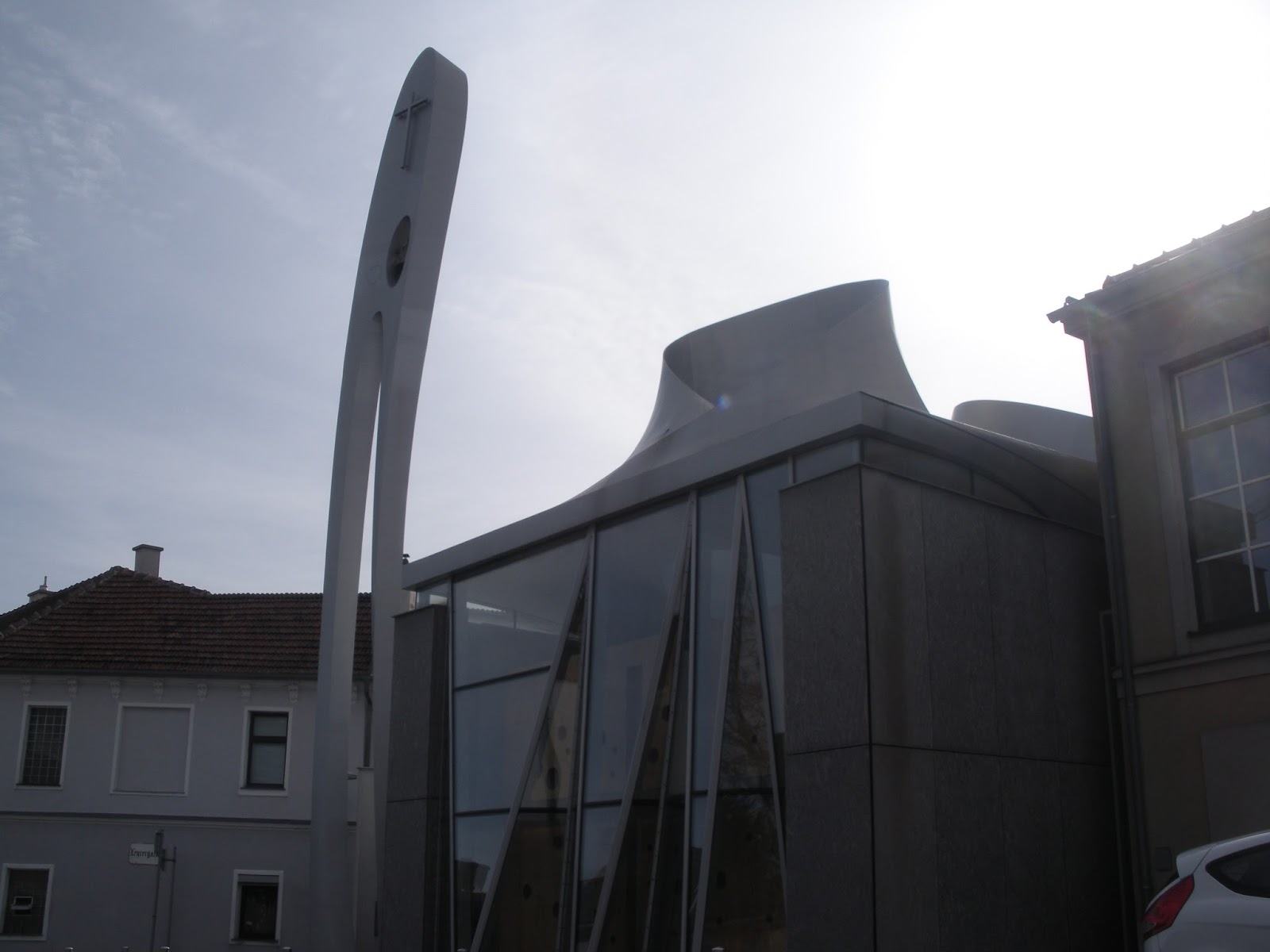
The day started at the early time of 7am. We had quite a bit scheduled for the day so off we went. The first stop was a ways out of town in Hainburg which is about 90 minutes away. It is about 5 miles from the Slovakian border. We went to a small church called Martin Luther Church designed by Viennese architects Coop Himmelb(l)au. They are also the architects of BMW Welt in Munich. It was a stark contrast between the two buildings. It really shows the range that Coop Himmelb(l)au is able to operate. The church was very small and the absolute max capacity was around 120 people. It was a cool little find in the middle of nowhere.
Martin Luther Church
I was hoping that would continue another 5 miles or so into Slovakia and its capital Bratislava but we started back to Vienna. Just a few miles down the road we came to Carnuntum. It was an old town that was a relic of the Holy Roman Empire. They reconstructed a lot of the buildings on the original foundations and set up the area like how it used to be. It was interesting to walk through but my interest wasn't piqued. I was more interested in a wooden playground on the site. From there we made our way back into the city of Vienna.
Roman Ruins in Austria
We stopped at another church this one called Church of the Most Holy Trinity or more commonly known as Wotruba Church. It was designed in the mid-1970s by sculptor Fritz Wotruba and architect Fritz Mayr. It is a very startling church. The whole design is based around these concrete blocks laid mostly vertically and glass windows placed between. This creates a very interesting interior and exterior condition. While it was intriguing to see I personally didn't like it.
Wotruba Church
We continued into the heart of the city arriving at Schönbrunn Palace which was the summer residence for the Habsburg Dynasty, the royal family of Austria. It was a very formally designed building as one would expect from a palace. We sort of rushed through the palace as every room looked the same and we wanted to see the gardens. Behind the palace lies the gardens, a zoo, a large 200 foot tall hill, and the Gloriette. This provided gorgeous views of Vienna and the surrounding area, We also got a quick bite to eat here before going on our way.
Rear of Schönbrunn Palace
The last stop of the day was the Church of the Holy Spirit designed by Jože Plečnik (who also designed a church I attended Mass in Prague). This church was similar to the one I saw in Prague albeit completed earlier. The rectangular/square open plan is readily apparent. It is of great use in churches where it provides satisfactory views of the altar from other seats. I enjoyed this church although I liked the one in Prague better.
Interior of the Church of the Holy Spirit
We bused back to the hotel following the church and had the rest of the night to ourselves. We had a group dinner at the hotel without Hans as he was visiting some family. It was nice to have a relaxing evening. Tomorrow, Hans has some buildings planned to see on the outskirts of the city.

Tuesday, March 29, 2016

The Vienna Voyage

Today is the first full day in Vienna (or Wien in German) and it was pretty packed. We started by taking a bus across the city to the first stop which was the Vienna University of Economics and Business. The new campus for the university was completed in 2013 after just three years and costing just under €500 million. The buildings were designed by Zaha Hadid, Laura P. Spinadel of BUSarchitektur, NO.MAD Arquitectos, Estudio Carme Pinós, Hitoshi Abe, and Peter Cook. Most of the buildings were pretty cool and responded well to the needs of the university though some of it seemed unnecessary. Despite that, the campus was pretty well laid out.
Library and Learning Centre by Zaha Hadid
The next stop was also a college called the Vienna University of Technology. We met up with the architect who did restorations/renovations and got a personal tour from him. The main stop of the tour was the cupola at the top of the building. It was a very interesting room to see. The structure was exposed and readily apparent. Once the tour was over it was time to go next door.
Cupola Hall at Vienna University of Technology
Just two buildings down was the Karlskirche. It is a church built by Johann Bernhard Fischer von Erlach and dedicated to Saint Charles Borromeo. It is considered one of the best baroque churches in Vienna and most outstanding buildings in the city. We have learned about this building a lot throughout our time in school. The plan isn't the typical plan of churches I usually see and its basis is around the elliptical dome. The drawback to this church is that there is scaffolding up to allow visitors to reach the top of the cupola. This takes away from the beauty of the church greatly. Plus it really isn't worth the visit to the top of the dome. There wasn't a whole lot to be seen. We finished up with the church pretty quickly and Hans took us on a walking tour.
Karlskirche
We walked around for a bit seeing some of the city before going to the Austrian National Library. It was built again by Johann Bernhard Fischer von Erlach in 1723. It was a very beautiful library and very elegant. I was thoroughly impressed with the building. There was so much history in the place that was also part of the palace. I wish I could've appreciated it more but I was super hungry after not being able to eat lunch. So Hans let us go and a group of us left to get dinner.
Austrian National Library
We made our way to Naschmarkt and had dinner. I had finally had true Wiener schnitzel made with veal. It was very good and delicious. We digested dinner a bit before heading back to the hotel. On our way we stopped at the Westbahnhof which is the main train station for West Vienna. It looks similar to the CCTV Headquarters in Beijing by OMA. Underground is a mall which we walked through. We decided to call it an early night being we start our day at 7am tomorrow, I hope whatever Hans has in store for us is great.
Westbahnhof

Monday, March 28, 2016

Long Day to Vienna

Today was a travel day. We were going from Salzburg to Vienna which is on the opposite side of the country. We left the hotel at 7am to make an appointment at 10am in Steyr which is about halfway. We got a tour of the Gartenhaus by the architect that designed it, Gernot Hertl. The building dates back to the 1600s and he took the bones of the building and transformed it into something new but old. Hertl uses the house as a summer home. It was an interesting complex but the heavy concrete walls transfer too much cold for me to be comfortable. Maybe it is just better in the summertime.
Gartenhaus
The second stop was just a little ways outside of Vienna in St. Pölten, the capital of Lower Austria. We walked around the Landhaus complex which is the government center of the city and the state of Lower Austria. The problem was that it is Easter Monday which is a federal holiday in Austria so everything was closed. So after a short peek around and some lunch it was time to hop back on the bus.
Part of Landhaus complex
We arrived in Vienna around 3:30pm and had a few hours before meeting back at the hotel for dinner. A group of us decided to go the aquarium around the corner called Haus des Meeres. The wild thing about this aquarium is that it is built inside of an old World War II anti-aircraft tower from 1944. It was amazing how they repurposed such a horrid piece of wartime weaponry. The layout was interesting and the animals were pretty cool.
Haus des Meeres
We walked around some more before heading back to the hotel for dinner. It was a long day and some rest is much needed before we start the truly extensive part of our journey. Look forward to more Viennese fun.

Easter in Salzburg

Today was our first full day in Salzburg. It is a quaint little city not far from the German border. Most people know Salzburg as the home of the Sound of Music. This city is full of character. Since today is Easter I felt I should attend church. I accompanied Rebecca and Hannah to Mass at the Salzburg Cathedral which is the main church for Salzburg dating back to 1628 when this church was completed. This was also the church that Mozart was baptized in. Mass was in German again but that was okay because they played a lot of music including Mozart which was a great, all-around experience.
Salzburg Cathedral
From there, we met back up with the rest of the group and went to Hangar-7 which is a display building owned and operated by Red Bull (whose headquarters are located in a neighboring town). The building consisted of this steel structure that spread out like a spiderweb and was enclosed completely by glass. It was an awesome building and one that asks a lot of architectural questions. We stayed there for a bit after getting a free coffee (which of course made the place that much better) and bused back into the city.
Hangar-7
Hans took us on a walking tour of the city. We started at the Mirabell Palace and Gardens which the Sound of Music filmed at. He explained to us the planning that went into it. It was a warmish Spring day and the flowers were blooming and people were out. This made the gardens more inviting. Next, was the Kollegienkirche (University Church) by Johann Bernhard Fischer von Erlach around 1707. The church was super cold. It had to be at least 10 degrees colder than the outside. And the church was stark white with little ornamentation and the altar was a lot smaller than most of the other churches of the time.
Kollegienkirche
Hans let us go from there. A small group of us took the time to photograph the two other churches we previously attended now that there weren't as many people in them. Once we finished with that we took an elevator up Mönchsberg, which is one of the mountains around Salzburg, to the Museum der Moderne. The views were great and the museum was nice. It was interesting to see how they built a museum on the cliff of a mountain.
View looking down on Salzburg
We walked from the museum up to the Hohensalzburg Castle on a neighboring mountain. This castle overlooks everything for miles in every direction. It provided beautiful views of everything. There wasn't much to see in the castle as it was actually closed so we took the funicular down after we got our fill.
Hohensalzburg Castle at night
We got dinner at an American burger place called Burgerista. It was fantastic. It was like a piece of home. Afterwards we got some Austrian beer at a bierhaus so you can't call us uncultured. It was a relaxing end to a busy 36 hours or so. Tomorrow we make the trip across the country to Vienna.

Through the Alps

Today we left the Villa bright and early at 7am. We have a chartered bus to take us through Austria which is nice not to have to deal with trains or public transportation. The ride to our first stop was absolutely, breathtakingly gorgeous. We drove through the Swiss Alps from a low elevation (896 ft) at Riva to an elevation of more than 5300 feet at one point. We even drove through the snow capped part of the mountains. It was so beautiful.
Swiss Alps
Our first stop took us to Vaduz which is the capital of the country Liechtenstein. I get to mark off another country on my list. We walked down the main pedestrian street that had a bunch of markets set up with a lot of people that actually spoke English. Everything smelled good although I didn't buy anything. We viewed the exterior of the architecturally significant parliamentary building before heading off.
Landtag of Liechtenstein
The second stop took us to Bregenz, Austria just over the Swiss border. Here we saw the Kunsthaus Bregenz by architect Peter Zumthor. It is an contemporary art museum that we have learned so much about in our years in architecture school. I was very excited to see it. The downside was we couldn't see inside the rain screen layers that make this building truly unique. It was still an interesting structure but left something to be desired.
Kunsthaus Bregenz

Our third stop was in the middle of nowhere on the German-Austrian border near a town called Erl. Here were two buildings called the Passionsspielhaus and the Festspielhaus. The Passionsspielhaus was built in 1959 by architect Robert Schuller. It is a orchestra theater that looks very much like a church. It was closed except for one door was left unlocked so naturally a group of us went inside. It looked abandoned although we found a poster for a show that occurred there two weeks prior. The auditorium was pitch black and covered in sawdust and the stage looked a mess (from what I could see thanks to my iPhone flashlight). I was sure we were in a horror film. But we made it out alive with a interesting story to tell. The Festspielhaus contrasts with the Passionspielhaus very abruptly. It is all black and cuts in horizontal lines that make it very modern. It was built in 1998 by Delugan Meissl Associated Architects. This building was completely locked up so we couldn't sneak in. With that we set off.
Passionsspielhaus
Festspielhaus
We finally reached Salzburg at 7pm, 12 hours after we set out on our journey. It was a long day and one that earned us some down time. Group dinner was right after we got our rooms and it was a buffet at the hotel which was decent. Following dinner, a small group of us went to Easter Vigil Mass at the Franciscan Church. We got there just as it was beginning and it was a unique experience and one that I was glad to be apart of. While I still don't understand German I love to immerse myself in the culture.

Monday, March 21, 2016

Spring Break comes to a close

Today was the last day of spring break. Like I've said before it is bittersweet. I am exhausted and I am ready to be stationary but there's nothing I would have done different. This spring break was a blast and I had so much fun and learned a lot. Rebecca was a great travel companion and made this week infinitely more fun than it otherwise could've been. With that it's time to start the last day.

The first thing on the to do list today was to check out of the Airbnb. We still had a few hours before we had to leave to go to the airport so we ditched our bags in the luggage lockers at the Prague train station. Since it was Sunday Rebecca and I were going to Mass. She picked out this church to attend that also happened to be on Hans list of buildings to see. After a bit of a hike we made it to the Church of the Most Sacred Heart of Our Lord. Mass was in Czech so obviously I didn't understand a single word but it was a nice place to be. It was unlike any church I have been in. It was a large square room that was double height or more with brick walls. The room was lined with engaged brick columns. It was such a beautiful building. It was a great experience.
Church of the Most Sacred Heart of Our Lord 
Church of the Most Sacred Heart of Our Lord Interior
We sort of ran out of time or else we were going to check out another building but we had to be back at the train station. The walk back was shorter since it was mostly downhill. From the train station we caught a bus to the airport. Caught our flight and then a bus to the main Milan train station and then a train back to Riva. It was a long day and an exhausting one after an exhausting week. It is good to be back to the Villa but there won't be much downtime as we have a project due Friday and leave for Austria on Saturday.

Some final thoughts on my Spring Break trip. I walked over 90 miles over the course of this trip which astounds me. Germany doesn't open before 10am on weekends. Germany also closes at 8pm everyday. Berlin was supposed to have this great nightlife that rivals New York yet we couldn't find it. Each city was unique in its own way. Munich is fairly walkable and is a mix of old and new architecture that keeps its old character intact. Berlin is not a walkable city as public transportation is a necessity and despite being a very old city everything is new and fairly recently built given it was pretty much demolished by the Allies in 1945. Finally, Prague is such an old city and it keeps its character as such. There isn't a lot of modern architecture but it isn't trying to be modern. It is fairly different in that regard. I loved my time in these three cities and wouldn't trade my experiences for anything.